China builds more prefabricated housing than any other country, and the industry is entering a new phase defined by government mandates, factory automation, and export growth.
1. Market Size and Growth Trajectory
Independent market researchers currently size China's prefabricated buildings sector differently depending on scope (residential only vs. all building types), but the direction is consistent: steady double-digit-adjacent growth through the rest of the decade. According to Mordor Intelligence, the market was worth an estimated USD 69.74 billion in 2026 and is projected to reach USD 97.86 billion by 2031, a compound annual growth rate of roughly 7%. A separate databook from ResearchAndMarkets, which measures the broader prefabricated construction output figure in local currency, put the industry at approximately CNY 1.62 trillion and forecasts it will approach CNY 2.47 trillion by 2029.
| Metric | Figure | Source |
|---|---|---|
| Market size, 2026 | USD 69.74 billion | Mordor Intelligence |
| Projected size, 2031 | USD 97.86 billion | Mordor Intelligence |
| CAGR, 2026–2031 | 6.99% | Mordor Intelligence |
| Concrete material share, 2025 | 58.40% | Mordor Intelligence |
| Timber CLT/LVL growth, 2026–2031 | 7.45% CAGR | Mordor Intelligence |
| Residential application share, 2025 | 53.65% | Mordor Intelligence |
| Broader construction output, 2024–2029 | CNY 1.48T → CNY 2.47T | ResearchAndMarkets / BusinessWire |
Growth is driven in large part by policy. Chinese authorities have pushed city and district governments to promote industrialized and prefabricated construction methods, with several provinces setting targets requiring a defined share of new urban floor area to use off-site methods. Building Information Modeling (BIM) mandates in Shenzhen and other tier-1 cities are also pushing digital design and quality-control workflows further into the supply chain, which is one reason larger, better-capitalized manufacturers have gained share in recent years.
2. Who Actually Builds Prefab Housing in China: The Manufacturer Landscape
"Chinese prefab manufacturer" covers a very wide range of companies, from state-owned construction conglomerates handling multi-story modular integrated construction (MiC) towers, to mid-size steel-structure specialists, to focused factories producing compact living units such as capsule houses, apple cabins, and container homes for hospitality, glamping, and workforce housing. Buyers sourcing internationally usually fall into one of the categories below.
| Category | Typical Output | Representative Players |
|---|---|---|
| State-owned / large EPC contractors | Multi-story MiC towers, precast concrete high-rises, large infrastructure | China State Construction Engineering Corp. (CSCEC), Beijing Urban Construction Group (BUCG), CITIC Construction |
| Industrialized housing developers | Panelized and modular residential blocks | Broad Group, Vanke Industrialized Building |
| Heavy steel-structure manufacturers | Multi-story steel frames, stadiums, airports, warehouses | Zhejiang Jinggong Steel, Anhui Honglu Steel Structure |
| Specialized light-structure / mobile-unit factories | Space capsule houses, apple cabins, container houses, folding modular rooms, portable sanitation units | Shanghai Cymdin Industrial Co., Ltd. and comparable regional factories |
This last category — compact, factory-finished units shipped as near-complete modules — is where most small hospitality operators, campsite owners, and residential buyers actually transact, because lead times and minimum order quantities are far more accessible than working directly with a large EPC contractor. Shanghai Cymdin Industrial Co., Ltd., founded in 2008 and operating a roughly 19,400 m² production facility in Jinshan District, Shanghai, is one such factory, focused on the New Space Capsule House, Apple Cabin, Container House, Modular Building, Circular House, Soundproof Cabin, Portable Toilet, and Double Wing Folding Room product lines described in Section 4 below.
3. Manufacturing Technologies and Materials
3.1 Precast Concrete (PC)
Precast concrete remains the dominant material category, accounting for the majority of prefabricated floor area nationally, largely because it integrates with existing Chinese building codes and mid-rise/high-rise structural engineering practice without major redesign.
3.2 Light-Gauge Steel Structures
Light steel frame systems using Q235B, Q355B, or higher-grade structural steel are common for villa kits, workforce housing, and single- to low-rise buildings. Panels are typically infilled with EPS, rock wool, glass wool, or polyurethane (PU) insulation and finished with color-coated steel sheet or aluminum composite panel. Reputable manufacturers design these systems to defined wind-load and seismic-load grades and certify them under ISO 9001 quality-management systems and CE conformity marking for export markets.
3.3 Modular Integrated Construction (MiC)
In MiC, entire room modules — including finishes, wiring, and plumbing — are completed in the factory and transported to site for crane-set assembly, with more than 70% of total construction work shifted off-site. This can compress project timelines significantly compared with conventional construction. Chinese contractors have used MiC to win pre-approval permits for multistory modular projects in overseas markets including the UAE, which industry representatives describe as evidence that Chinese modular construction is moving from meeting international standards to helping define them.
3.4 Container Conversion
Shipping-container housing repurposes ISO steel freight containers or purpose-built container-profile steel frames. Because the base structure is already engineered for stacking and marine transport loads, converted container units tend to have strong inherent load resistance, and the format lends itself to rapid export logistics.
3.5 Emerging Structural Materials
Research institutions have also developed novel composite structural panels — for example, an ultra-light sandwich panel built from stainless steel plates with an internal tube-core array — designed to improve seismic and typhoon resistance while cutting embodied carbon substantially versus conventional reinforced concrete. Timber CLT/LVL systems are a smaller but faster-growing segment, driven by embodied-carbon reduction goals.
4. Product Categories Buyers Actually Order
For buyers outside the large-scale residential-tower segment, purchasing decisions usually center on a specific finished-unit product type rather than a construction method in the abstract. The table below summarizes the main compact prefab product categories currently in demand, using Cymdin's product range as a reference point for typical specifications and use cases.
| Product | Typical Use Case | Notable Features |
|---|---|---|
| Space Capsule House | Off-grid stays, resort pods, scenic-area lodging | Corrosion-, insect-, fire- and water-resistant shell; solar/wind self-power options; earthquake- and windproof design |
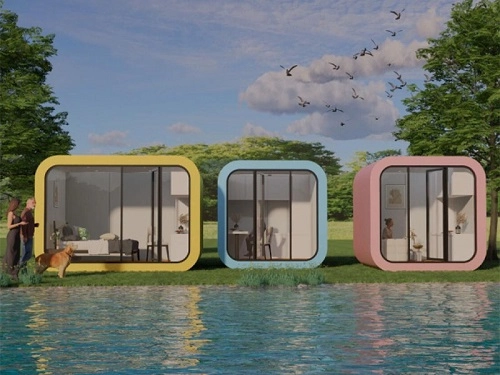
| Apple Cabin | Glamping, boutique hospitality, backyard studios | Rounded-arc modular shell, stackable/combinable units, foundation-free deployment |
| Container House | Workforce housing, retail pop-ups, temporary offices | High-strength steel shell rated for stacking and transport loads |
| Modular Building | Multi-room residential or commercial layouts | Factory-finished room modules for on-site assembly |
| Circular House | Statement lodging, cafés, viewing pavilions | Curved architectural profile with custom finishing |
| Soundproof Cabin | Home offices, music/recording rooms, meeting pods | Acoustic-rated panel construction |
| Portable Toilet | Construction sites, events, public facilities | Modular sanitation units, low install time |
| Double Wing Folding Room | Rapid-deployment housing, disaster relief, mobile camps | Container-footprint transport, expands to full room configuration on site |
For a deeper technical walkthrough of a specific line, Cymdin's editorial team has published buyer-focused breakdowns such as the C06 Apple Cabin Container House technical and buyer's guide and coverage of seasonal use cases like the C08 apple cabin for summer hospitality deployments. The full model range, including individual unit variants, is browsable from the main product catalog.
5. Certifications and Quality Standards to Verify
Because "prefabrication rate" and structural performance are calculated differently across China's 28 provincial-level regions, third-party academic research has found that the same building can receive materially different prefabrication scores depending on which regional standard is applied. This makes supplier-level certification — not just marketing claims — the more reliable signal for buyers.
| Certification | What It Verifies |
|---|---|
| ISO 9001 | Documented quality-management system across production |
| ISO 14001 | Environmental-management practices in manufacturing |
| CE marking | Conformity with applicable EU health, safety, and environmental requirements |
| SGS inspection reports | Independent third-party verification of materials and finished units |
| Seismic / wind-load grade rating | Engineered performance under regional earthquake and typhoon conditions |
You can review Cymdin's own quality documentation, factory photos, and production history on the certificate page and factory overview page, or read the company's background on the our story and history pages.
6. Export Trends
China's prefabricated-building exports (customs code HS 9406) reached a wide and diversified set of buyers in early 2026. Trade data covering January–May 2026 shows shipments to 218 partner markets, with the largest single HS sub-category (HS 940690, a broad residual classification) valued at roughly USD 1.89 billion and growing 33.9% year-on-year. Notably, no single destination market accounted for more than 10% of total export value, and the top two destinations combined represented only 18.3% — a level of diversification uncommon among Chinese export categories, which reduces buyers' exposure to any single country's trade-policy risk.
7. How to Evaluate a Manufacturer Before Ordering
Factory verification: Ask for a virtual or in-person factory tour; Cymdin, for example, offers a factory VR walkthrough.
Documented certifications: Request ISO/CE/SGS documents directly rather than relying on website badges.
Structural ratings: Confirm published seismic grade, wind-resistance grade, and fire rating for your climate zone.
Customization capability: Confirm whether size, layout, insulation type, and finish are configurable, or fixed to standard models.
After-sales support: Clarify warranty length and whether technical support is available post-installation.
Track record: Years in operation and number of export markets served are reasonable proxies for production maturity.
8. Frequently Asked Questions
Is prefabricated housing from China durable enough for permanent residential use?
Yes, when engineered to appropriate structural standards. Steel-frame and container-based units from certified manufacturers are commonly rated for defined seismic and wind-load grades, and manufacturers increasingly publish these ratings alongside ISO/CE documentation.
What is the difference between a container house and a modular building?
A container house is typically based on (or profiled to match) standard ISO shipping-container dimensions and structural characteristics, while a modular building refers more broadly to any factory-built room module, which may follow non-container dimensions and be combined into larger multi-room layouts.
Do compact prefab units need a foundation?
Many space capsule houses, apple cabins, and container units are designed for foundation-free or minimal-foundation installation, though local building codes and site conditions ultimately determine what's required.